Friday, 20 September 2019

#Software_Learning Hot Potatoes

Using “Hot Potatoes” to Create Interactive Exercises

I. What is “Hot Potatoes”?
       
        The “Hot Potatoes” is a suite of quiz/drill-authoring software created at the University of Victoria, Canada. It includes six applications, enabling you to create interactive exercises:

l      multiple-choice quizzes (JBC)
l      gap-fill exercises (JClose)
l      text-entry (short-answer) exercises (JQuiz)
l      crosswords (JCross)
l      jumbled-sentence/jumbled-word (drag-and-drop) exercises (JMix)
l      ordering/matching (drag-and-drop) exercises (JMatch)

Now you can go to the tutorial folder to look at some examples of the kinds of exercise you can make using Hot Potatoes.

II. How can you download and register “Hot Potatoes”?

        This software is free of charge for non-profit educational users who make their exercises available on the web. However, if you are working in a commercial context, you need to pay for a licence. You can download “Hot Potatoes” version 5.5.0, self-extracting, auto-installing zip file at http://web.uvic.ca/hrd/hotpot/#downloads.

Whether you are commercial or otherwise, you need to register the programs. You have to fill in a form on their website http://142.104.133.52/admin/register.htm and get a registration key from them. You will use your personal key to unlock all the features of the programs. When you receive the key, simply start one of the Potatoes (any one will do), then click on the Help menu and choose Register. Then you can enter your User Name and Key.


III. Do you need to know HTML or JavaScript to use “Hot Potatoes”?

        No. All you need to do is to enter your data – texts, questions, answers, etc. The program will create the webpages for you. However, the programs are designed so that almost every aspect of the pages can be customized, so if you do know HTML or JavaScript, you can make almost any change you want to the way the exercises work.


IV. Three Steps in Making an Exercise:
1.       Entering data (questions, answers and so on) and save it as a data file.
2.       Configuring the output (preparing the button captions, instructions, and other features of your Web pages)
3.       Creating Web pages (compiling your exercise into HTML or DHTML pages) and view your work.
Step 1: Entering Data
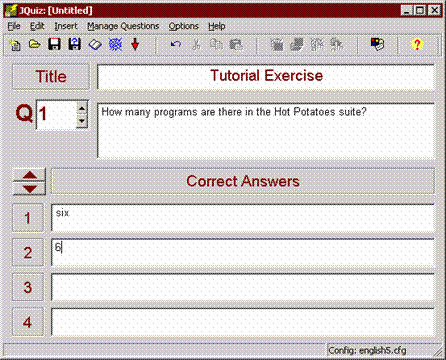
For example, we're going to make a text-entry exercise using JQuiz. The first stage is to enter the questions and answers for your exercise. Start the JQuiz program, then enter the title, question and two answers that you see in the picture below.
Note that we have entered two possible variations of the answer: the word "six" and the digit "6". This means that the program will accept either of these answers as correct.
Once you have entered your data, you need to save it, in case you want to change it later. Each of the Hot Potatoes programs saves data in its own special file type; in JQuiz, the files end with the ".jqz" extension. It is important to save your data, since the programs cannot reload Web pages to make changes; the only way to change your Web pages is to reload the data file, make your changes, and then regenerate the Web pages. Call your file "test", or something similar. Then the file name "...\test.jqz" should appear in the caption of the JQuiz program.
Step 2: Configuring the Output
When a Hot Potatoes program creates Web pages, it does so by combining 3 resources:
  1. The data you entered
  2. The configuration information
  3. A set of "source files", or templates, containing the page structure.
We have already looked at data; the next step is Configuration. The configuration information is a collection of pieces of text, including instructions for doing the exercise, button captions, and link URLs, which are unlikely to change much from one exercise to another. For example, all of the sample exercises you looked at earlier in this presentation included a button labelled "Check", so that the student could check his or her answer. The caption "Check" is not likely to change from exercise to exercise, so it does not need to be stored with the data; however, you may need to change it (if you are creating quizzes in another language, for example).
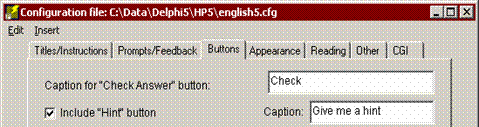
You can get access to all the configuration information by choosing "Configure Output" from the Options menu. We're going to make two changes to the configuration; first of all, we're going to change the caption of one of the buttons, from "Hint" to "Give me a hint". When you see the Configuration screen, click on the "Buttons" tab, and change the entry for the Hint button, as you see below:
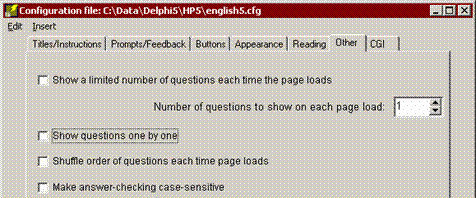
Next, we're going to change one setting on another page of the Configuration screen. If you click on the Other tab, you'll see a check box for making the exercise case-sensitive. You'll remember that our two correct answers were "six" and "6"; however, it would be sensible to accept "Six" or "SIX" too, so we're going to uncheck that box (it may be unchecked already; in that case, just leave it alone). Then the exercise will not be case-sensitive, and all of these variations of "six" will be accepted:
When you have made your changes, press "OK" to go back to the main screen.

Step 3: Creating a Web Page
The final step is to create a Web page from your data. All you need to do is click on "Create Web page" from the File menu, then give your page a filename. Use the filename "test.htm".
The program will tell you that it has produced a file, and let you view it in your browser. (Note that the single-file output is an improvement over previous versions of Hot Potatoes, when three or more files would be produced for each exercise.) All you have to do now is upload that file to your Website, and you have a working exercise.

Wednesday, 28 August 2019

Micro. Teaching #B.Ed.....

MICRO TEACHING

●"Micro teaching is a scaled down teaching encounter in adown teaching encounter in a class size and class time".class size and class time". 

● The number of students is from 5-10, and the duration of period ranges from 5-20 minutes. ALLEN (1996)

● Micro teaching is a deviceMicro teaching is a device which provides the novicewhich provides the novice and experienced teacherand experienced teacher alike new opportunities toalike new opportunities to improve teaching.improve teaching. ● It is a real teaching with a scaled down time and size of the class.

 HISTORY
● The idea of micro teaching originated for the first time in STANFORD UNIVERSITY,STANFORD UNIVERSITY, USA.USA.
● The term "MICRO TEACHING" was coined in 1963.

 ASSUMPTIONS 
● Is based on Skinner's operant conditioning.
 ● Teaching is a complex process but it can be analyzed into simple skills.
 ● Teacing skills can be practised one by one up to the mastery level under specific and simplified situations.
 ● Appropriate feedback, if systematically given proves very significant for obtaining a mastery level in each skill.
● When all skills have been mastered, taken one by one, then they can be integrated for real class room teaching.
● Skill training can be conveniently transferred from a simulated teaching situation to the actual classroom teaching situation.
● Teaching skill is a set of behaviours or acts of the teacher that facilitate student's learning.
 ● Teaching is observable, definable, measurable and demonstratable and can be developed through training.
● Micro teaching is a teacher training technique that plays a significant role in developing teaching skills in the student teachers.

THE CONCEPT
● A single skill for practice. ● One concept of content for teaching. ● A class of 5-10 students. ● 5-10 min of practice time.

. STEPS OF MICRO TEACHING 

STEPS


. PLAN

● This involves selection of a topic and related content.
 ● The topic is analysed into different activities of the teacher and the students.
. ● The activities are planned in logical sequence.

TEACH
● This involves the attempts of the teacher trainee to use the components of the skill in suitable situations in the process of teaching – learning as per the role or the planning activities.
 ● If the situation is not different and not as visualized in the planning of the activities, the teacher should modify his or her behaviour as per the demand of the situation of the class.
 ● The teacher should have the courage and confidence to handle the situations arising in the class effectively.

FEEDBACK 
● Refers to the giving information to the teacher trainee about his performance.
. ● This helps the teacher trainee to improve his or her performance in the desired direction.

RE-PLAN
 ● The teacher trainee replans his lesson incorporating the points of strngth and removing the points not skilfully handled during teaching in the previous attempt either on the same tiopic or on another topic suiting the teacher trainee for improvement.

 RE-TEACH
● This involves the teaching the same group of student if the topic is changed or a different group of students if the topic is same.
 ● This is done to remove boredom or monotony in the students.
● The teacher trainee teaches the class with renewed courage and confidence to perform better than the previous attempt.

RE-FEEDBACK
● This is the most important component of micro teaching for behaviour modification of the teacher trainee in the desired direction in each and every skill practice.


. PHASES OF MICRO TEACHING 
● KNOWLEDGE AQUISITION PHASE.
 ● SKILL AQUISITION PHASE.
● TRANSFER PHASE.
. KNOWLEDGE AUISITION PHASE

● The trainee teacher learns about the skills and its components through discussion, illustrations and demonstration of the skill given by the expert.
● The trainee teacher's analysis of the skill into components leads to various types of behaviours to be practised.
● The trainee teacher tries to gain the skill from the demonstration activity given by the expert.
. ● He discusses and clarifies each and every aspect of skill.
 SKILL AQUISITION PHASE
 ● On the basis of the demonstration presented by the expert, the teacher trainee plans a micro – leson plan for practicing.
● He practices the teaching skill through the micro teaching cycle and continues his efforts till he attains the mastry levels.
● The feedback components of micro teaching contributes significantly towards the mastry level aqcusition of the skill.
● These skills are called the "core skills"
● These skills are called core skills because of their extensive use in classroom teaching.

ADVANTAGES
 ● Visual feedback (watching a recorded session) has been found to provide one of the most effective means of evaluating teaching strengths.
 ● Micro teaching enables both intrnsic (self assessment) and extrinsic (peer assessment) review.
 ● Micro teaching provides opportunity for practicing part of lecture activity, practicing a guest lecture, before delivering a course, demonstration in lab for first time, practicing a job talk, practice public speaking skills before you address students for the first time, polishing your skills if you are an experirnced person.
.★CHALLENGES
 ● Time consuminng.
● Trainee teacher may get a feeling of saturation or get bored with repeated teaching sessions. ● Trainee teacher may lose self confidence if she or he is asked to repeat the classes several time.


Characteristics of micro teaching
1. It is a teacher training technique and not a teaching method.2. It is a real teaching, though the teaching SITUATION IS SIMULATED.3. In micro teaching teacher trainee practices one a specific teaching skill at a time, till he/she attains mastery over the skill.
4. It is a scale down teaching encounter in class size, content, class time.
5. It operates on a predefined model. Plan, teach, feedback, re- plan, re- teach, re-feedback, etc.
6. It allows for increased control of practice by providing feedback to the teacher trainee.
7. It is not a substitute but a supplement to the teacher training programme.
8. It is a cyclic process. The pre decided model is repeated till the trainee achieves the expected level of mastery.
9. It is a highly individualized training device.

Uses of Micro Teaching

• Helps in reducing the complexities of the normal class room teaching.
• Helps the teacher trainee gain more confidence in real teaching,
• It creates among the teacher trainees an awareness of various skills of which teaching is composed of.
• It simulates the class room scene and gives the teacher trainee an experience of real teaching.
• It helps in systematic and objective analysis of the pattern of class room communication through specific observation schedule.
• It is more effective in modifying teacher behaviour.
• It is an effective technique for transfer of teaching competencies to the class room.
• It helps in getting acquainted with class room manners to a certain extent.
• Feedback enables the teacher trainee to consciously concentrate on specific behavioural modification.
• It helps the teacher trainees in better understanding of the meaning and concept of the term teaching.

Demerits
• Micro teaching is skill oriented and not content oriented.
• It covers only a few specific skills.
• Lack of material resources like video recording facility and trained supervisors.
• The question of integrating the skill is quite challenging.
• Teaching is not just a summation of teaching skills.
• Sufficient literature on micro teaching is not yet available.


Saturday, 11 May 2019

Trial And Error Make You Strong .......


Previously in my #Sem 2 I have also tried to Build my own application on online platform, on this site click here for visite name of the site if Apps Geyser but there are some error which I have made  but by the time passes At the end of my masters I've My own Application which I Prepared By my Own ...... 😊 Happy to  Sharing With You All Because Sharing  Is caring ........🍁😊


https://sites.google.com/view/niyatipathaks-e-portfolio/home
Whole site .....


Yesterday .. #Mahesh_Jivani sir from #Saurashtra_university
Conducted Live Session on 'Converting  Website Into Movile Apk' Application Was Build in application which we only can operate on PC click here for build your own app by your own It's so easy to Prepare ..... 

To Download  My Application Of Application ...Click here 

Saturday, 4 May 2019

#Book_Review #One Night @the Call Center popular book by Chetan Bhagat

One Night @the Call Center popular book by Chetan Bhagat. As we know that Chetan Bhagat write about the young generation. He present the real situation of the society. He show that how people live in the society and face the problem. 
       In One Night @the Call Center present the how in modern society people live and work. Here he talk abut six character who work in one call center. In on@tcc Bhagat beautifully decribes the life of workers of the call center, he observe their life style and put all the characters in same situation. Workers of the call center are normal human being like us; they also face some kind of problem in their life. Every character has their desire but at some extent doesn’t fulfill it. Here in this novel Bhagat’s tone is pitch-perfect because he describe contemporary problem in his novel and even today call center are not highly regarded by society, so Bhagat keenly observe all this thing.
         Manippean Satire is a serio-comic genre. The novel ON@TCC is considered as Mannepean satire, in which we find that these characters suffer from the problems in their lives. In this novel Chetan Bhagat represent the idea of bossism that the boss of call center who has a power over these six characters. In this way writer criticized who has power to rule other people.
          We see that Chetan Bhagat use very simple language. So easily understand the point of view of the book.In his works he writes about the contemporary issues that readers like to read and they choose this type of popular literature.   
           One Night @the Call Center as a self-help book because we many characteristic of the self-help book like in the book he give one activity, this activity present the self-help book as well as. Also when all character go for picnic that time they all in problem that time god call them. And give instruction that also present the book is a self-help book.   

#Movie_Review #slumdog_Milinaire

“Slumdog Millionaire” Directed by Danny Boyle

                                                   “Slumdog Millionaire”


              The movie “Slumdog millionaire”  is based on the novel “Q and A” by Vikas Swarup. The movie translated in 42 languages. It is the British film but use the Indian Background also luck play vital role. Also we can see the elapses technique use in this movie.


             The film “Slumdog millionaire” directed by Danny Boyle. It is the 2008 British drama film. The movie start with the character of Jamal malik. He was slum boy from the Juhu slum. The main character of  the entire film. Jamal malik was not intelligent but he has very intitutive boy.  Also we can find that the satire on rich and super class people. Also satire on acquirer’s language. Here, we can say that,

“his learning from life,
I educated for the life”

               Dubbed the feel good film of the decade, "Slumdog Millionaire" is the film to see. Excitement, tragedy, love and hate it's all featured together. The film starts by showing the poverty in India. The way that it does this is in a humorous but serious way and therefore still getting the point across. The film then goes into show how the poor and rich are living together; side by side and how there is a large divide between classes. Two Brothers Jamal Malik (Dev Patel) and Salim Malik (Mahur Mittal)are taken in by a villain who forces the children beg so that he makes money. They escape from this villain leaving behind them there friend Latika (Freida Pinto). After living rough the brothers manage to find Latika but they then become separated. Jamal ends up working in a call centre as a tea boy and this is how he locates his brother. He then knows that if he gets onto "Who Wants to Be a Millionaire" Latika will see him. Working at the call centre is then his gateway to "Who Wants to Be a Millionaire".


                   Slumdog Millionaire is the story of Jamal Malik, an 18 year-old orphan from the slums of Mumbai, who is about to experience the biggest day of his life. With the whole nation watching, he is just one question away from winning a staggering 20 million rupees on India’s “Who Wants To Be A Millionaire?”But when the show breaks for the night, police arrest him on suspicion of cheating; how could a street kid know so much? Desperate to prove his innocence, Jamal tells the story of his life in the slum where he and his brother grew up, of their adventures together on the road, of vicious encounters with local gangs, and of Latika, the girl he loved and lost. Each chapter of his story reveals the key to the answer to one of the game show’s questions. Intrigued by Jamal’s story, the jaded Police Inspector begins to wonder what a young man with no apparent desire for riches is really doing on this game show? When the new day dawns and Jamal returns to answer the final question, the Inspector and sixty million viewers are about to find out.

                  At last we can observe that, dishonest people are hero in this movie, how character of nation is build, and the great Indian people goes on the great and success dream , nation and narration how happens in this film, representation of character and nation, the portrayed of character is wonderfully saw the movie. 

Monday, 22 April 2019

Rivers and Tides: Andy Goldsworthy Working with Time


Rivers and Tides: Andy Goldsworthy Working with Time
Directed by Thomas Riedelsheimer

An extraordinarily spiritually literate documentary about one of the world's greatest nature artists.

Andy Goldsworthy is an artist of nature. He creates sculpture from materials he finds outside, such as driftwood, stones or flowers. His work is amazing. Before the tide comes in, along a river bed, as it rains, or even as the seasons change, Andy’s work changes as nature takes its course, and he alters the look of each of his artistic pieces. He always takes photos to show how his work evolves. You will watch as a leaf snake travels down a river, the tide overtakes a cone-shaped statue he makes out of stones, the sun changes the look of his art on land, and like a river, the wall of stone he creates weaves in and out around the trees. Goldsworthy also describes his thoughts and reasons for the art.
The film also looks into life and family of this creative man and how he uses the materials around him in the process of creating his art. You’ll be drawn in to the fascination of one man’s imagination as it comes to life and then changes direction, as well as the thought process he goes through regarding his art and the peace he finds in his solitude when he works.

The wall at Storm King

The wall at Storm King is a 2778 feet stone sculpture in the New England region of America. It has been erected over a decimated wall that stood on the abandoned farmlands that once existed in the region. Although being built to last, it is made using no adhesive material, instead chipping the stones in order pile them. The meandering wall is 42 chains long according to the old British system which matches Goldsworthy’s age at the time. The materials used were select stones, pickaxes and the effort put in by a few stone wallers working on Andy’s instructions. The mediums used to hold the material together are the qualities of the stone such as weight, solidity and malleability.  It takes the form of a river, meandering at various points to mimic its flow. The content of the sculpture is the entire wall in itself, a river of stone. The subject matter would then be Andy’s perception of rivers, the embodiment of change to him, even in static form. An analysis from the Neo-formalist perspective would best classify it as art since it displays a satisfying relationship between the content, fluidity and the form of the river, associated even when in static form. 

Sheep’s wool on a dry stone wall


The name ‘Sheep’s wool on a dry stone wall’ essentially describes the nature of the artwork itself. Goldsworthy took unprocessed wool from local sheep and laid it over an uneven dry stone wall to create this piece. Dry stone walls and sheep have been closely associated in social heuristics for centuries, the walls being made in order to contain domesticated sheep within particular boundaries. As a result of both the sheep’s trampling and its relish for ground level fauna, no major forests develop in areas inhabited by them, especially the traditional domestic grasslands. This is what Andy Goldsworthy fed off, portraying the sheep’s dominance over its surrounding despite being such seemingly humble creatures. If dissected, the materials applied would be existing dry stone walls, sheep’s wool. The mediums used to form it would be the solidity of the stone wall and the course rigidity of the wool which held it in place. It takes the form of a river made up of wool, the unevenness of the wall acting as the meanders of the river. The content of the piece is the flow of life over the land, symbolised by sheep’s wool and stone. Therefore, the two components would be the river of sheep and the mountain/wall of stone. The subject matter would again be Goldsworthy’s perception of rivers and their co-relation to life as a whole. The Representation theory of art would best classify this piece as art in my opinion since both the stone and the wool stand in as symbols of life and land respectively.

Unnamed wooden eddy


Andy Goldsworthy metaphorically feeds off his observations in nature, drawing inspiration from forms in movement. In this unnamed whirlpool, he displays the culmination of his perceptions of the whirls formed in the water of a river. This river in Canada flows along a rocky route which often causes small whirls known as ‘eddys’, due to stone obstacles in its path. Goldsworthy piled together wodden twigs from trees nearby to create a large, hollow dome shaped eddy, captured in time. It does not remain static however, and is designed to mimic the movement of the eddys when the high tide sets it afloat. As it disintegrates, it joins the eddy’s of the river in a flow of circular movement. The material used in this case would be select twigs, broken into to defined size. The medium would be the buoyant quality of the wood and the flowing quality of water. Its takes the form of a dome shaped whirl made up of straight lines piled and angled accordingly. The content would be the entire piece in itself and the subject matter would be the effect of the obstacles on something as fluid as water, hence adhering once again to Andy’s perception of rivers and tides. Since it displays both significant form and intent, this piece may be labelled art by the Formalist theory of art. 


Just as Goldsworthy sculpts nature, Fred Firth, the music composer who worked on the documentary sculpts silence to meander and change with the artworks at opportune times, adding a fluidity to something digital.

I find his ephemeral projects the most satisfying.  For instance, Goldsworthy makes a chain of leaves held together with thorns.  He then places it in the stream and watches it.  As the chain flows down the river, it threads itself through rocks and riffles, when it moves through a pool it begins to spirals; ultimately it becomes a visible line we can read, a register for the forces in the water.  In another project, he collects red rocks from the bottom of the stream and grinds them up into a fine powder.  Placing the powder in the small neighboring pockets of stone creates shocking blood-red pools.  A simple action, yet he draws many parallels between rock and life, the cycle of stone from sediment to rock and back.  He exposes what was there but unseen.
Overall the film is slow paced but with excellent visuals and music by Fred Frith it’s a pleasure to watch.  Here are a few screen captures I grabbed of the film.

Friday, 19 April 2019

Arundhati Roy's The God of Small Things


AUTHOR: Arundhati Roy is an award-winning author and an active human rights activist. Roy has personally experienced the marginalisation and discrimination in her childhood. Roy, her brother and her mother Mary Roy were marginalised by the Syrian Christian community they belonged to. They were unwelcomed by the community and the relatives for being the children of mixed religious marriage.
Arundhati Roy is an Indian author. Roy has received the Man Booker's Prize of 1997 for the novel The God of Small Things (1997). In the novel THE GOD OF SMALL THINGS (1997) Roy depicts the social discrimination of women, children, untouchables, migrants and different races. The novel provides the detailed analysis on the major and minor aspects of marginalisation highlighted in the novel The God of Small Things (1997).
Arundhati Roy said in the interview with the Hindu, “What I want to write I cannot describe. It is akin to breathing, and the air we breathe has caste, gender, Kashmir, love, animals, trees and other things. We can’t write if we are afraid, afraid of intimacy or politics, or of making the background become foreground” (See https://www.thehindu.com/…/you-cant-wri…/article19938276.ece).
NOVEL: The God of Small Things (1997) is the first award-winning novel by the Indian author Arundhati Roy. In 1992 Arundhati started working on the manuscript of her first novel The God of Small Things (1997). It is a semi-autobiographical novel. The major part is about her childhood experiences in Ayemenem. This novel was published in 1997. It received the ‘The Man Booker Prize’ in 1997 and was published in 40 languages around the world.
It was the most appreciated and the most controversial novel at the same time. Most of the novel covers Roy’s experiences and keen observation of Indian society. This novel is not linear, but it goes back and forth, present and past memories as the stream of consciousness.
Ammu’s character is not as strong as Mary Roy was in real life and so she gives up fighting the odds-on life too. Mary Roy was a Women Rights activist and a strong individual who fought for her rights and raised her children with unconventional education of humanity and feminist values outside the fixed social norms of those times. Arundhati Roy’s mother was an uncompromising feminist and a social activist.
Ammu’s character has tragic flaws, which bring the tragic fall of not only the heroine but also affects her loved ones. Ammu is vulnerable and willing to fall in love with anyone who will give her attention she has to find love outside of the community, as the community has marginalised her and her children altogether.
'The small things' are the protagonist Ammu and her Dizygotic twins Rahel, the main narrator and her brother Esthappan. According to the Syrian Christian community, as Ammu is married out of the community to a Hindu and even divorced him, she is marginal. Ammu, Rahel and Esthappen are so small things to the community that their lives do not matter to anyone except Velutha. ‘The God’ in the novel is Velutha, who himself is marginalised by Indian society as an untouchable. Velutha loves Rahel and Esthappan and their mother, Ammu without any condition. Hence he is punished and killed by the privileged community.
Estha faces the abuse at the public place and his family cannot provide protection. As his mother, Ammu says that one cannot trust anyone. As Estha is having a pragmatic approach to everything, he feels it is the best thing to be prepared for any situation. “Because Anything Can Happen to anyone,” Estha said. “It’s Best to be Prepared” (198).
Velutha is the tragic hero of the novel The God of Small Things (1997). Velutha is the son of a fisherman identified as Paravan from Kerala and is treated as untouchable not only by the Hindus but also by the Christian; though he and his father have accepted Christianity.
CONCLUSION: It is an omnipresent narrative with Rahel as the main narrator. It is the story of the fraternal twins Rahel and Esthappan, their mother Ammu and people connected to them. Roy focuses on the marginalisation of women. Marginalisation of children is shown through the main narrator Rahel and her brother Esthappan, in the novel children are denied love, care and safety by the family of their own. The powerful community marginalises Velutha for belonging to depressed classes and treated him as an untouchable.
Hi! Friends feel free to comment on your point of view on the novel. If you want more information, let me know and I'll work on it.

Saturday, 6 April 2019

Development of T.V. in Indian”

Name : Niyatiben  Anirudhbhai Pathak
Paper: - Mass Media & Communication  
Topic: Development of T.V. in Indian”
Enrollment No:_2069108420180042
Email Id ... napathak02@gmail.com 
Batch :-2017_2019
Submitted To: Department of English, MKBU


  • Synopsis ...
  • Introduction of Television
  • .Development of Television  in India:-
  • .History of the Television
  • There are many television genres:
  • #....ADVANTAGES OF TELEVISION.
  • ...DISADVANTAGES OF TELEVISION


#..... Introduction of Television
“Television means an electric communication medium that allows the transmission of real time visual images, and also sound.”

Tele means “From far away”
Vision means “To See”
Television means a device to which a picture and sound can be broadcast by means of radio waves or a cable.
Television is a telecommunication medium for transmitting and receiving moving images that can be monochrome means black and white or colored, with or without accompanying sound. “Television” may also refer specifically to a television set, television programming, or television transmission.
Television grownup as a great medium for entertainment, knowledge, education, etc. in our language Television means “Doordarshan and now known as TV. TV is a short form of television. As we all know in this 21st century the role of technology plays very vital role in every field like, education, business, agriculture, etc. Television is one of the great technological tools for the mass communication. Television is one of the helpful medium for the viewers. It provides information, communication and entertainment.

#......Development of Television  in India:-

TV is one of the major mass media of India and is a huge industry and has thousands of programmers in all the states of India. Approximately half of all Indian household own a television. As of 2010, the country has a collection of free and subscription services over a variety of distribution media, through which there are over 515 channels and about 59 are paid channels. National telecasts were introduced in 1982. In the Indian market, Indian small screen programming started off in the early 1980s. At that time there was only one national channel Doordarshan, which was owned by the government. The Ramayan and Mahabharat were the first major television series produces around 1980s. TVs viewers increased in large number though there was only one channel. Later on Foreign channels like CNN star TV and domestic channels such as Zee tv and Sun tv started satellite broadcasts. Starting with 1 set in 1962 and one channel, by 1991 TV in India covered more than 70 million homes giving a viewing population of more than 400 million individuals through more than 100 channels.   

     #.....History of the Television

    Television started as a modest affair in India on September 15. 1969 when the AIR set up an experimental television service in Delhi. It was soon converted into a full-fledged telecasting station. Bombay was the second city in India to open a TV centre on October 2, 1972.
    A television centre was commissioned at Srinagar (Kashmir) on January 26, 1973 and another was opened at Amritsar (Punjab) on September 29, 1973. A relay centre was set up in Poona (Maharashtra) on October 2, 1973. In August 1975 Calcutta (West Bengal) and Madras (Tamil Nadu) opened TV centers.
    The Television set-up was declined from All India Radio and, under the name "Doordarshan", given the status of a full-fledged Directorate with effect from April 1, 1976. Separation of television from AIR was intended to facilitate fuller development of this medium and the specialized skills peculiar to it.
    Doordarshan has at present seven Kendra’s located at (1) Delhi, (2) Bombay (with a relay centre at Pune), (3) Madras, (4) Calcutta, (5) Srinagar, (6) Amritsar and (7) Lucknow, besides 3 Base Production Centers at Delhi, Cuttack and Hyderabad.
#....There are many television genres:
Education
Music
Animation
Infotainment
Sitcom
Entertainment
Religion
Family
Crime
Cartoon
Science
Soap opera
Thriller
Documentary
Drama
Arts and Culture
Adventure
Tele novella
News
Historical
Comedy
Talk show
Education
Weather
Game show
Reality show
Shopping
Business
Sports
Horror
Travel
Nature
#...Comedy Shows
   Television is a great medium for entertainment. Now a days in every house we find television and people love to watch television in their free time. Every person like from children to old age people prefers to watch comedy programs, which gives laughter and entertainment to the audience.    
Example:Comedy Night with Kapil:
  A comedy night with Kapil is an Indian comedy show. This is one of the great comedy show presented by Kapil Sharma. In this type of comedy show we find celebrity guests who usually appear to promote their latest films in a comedy focused talk show format. This comedy show became India’s highest rated scripted TV Shaw.
Taarak Mehta ka Ooltah Chasmah:
Taarak Mehta ka Ooltah Chasmah is one of the great comedy serial in which we find many comic elements. In this comedy serial. We see that there are many families who live in one society and their aim is to live in unity in their society. In this serial there is leading character namely Jethalal who finds difficult situation everywhere and its create laughter to the audience. The aim of this comedy serial is to make laugh and entertain to the audience in a various ways.

#....ADVANTAGES OF TELEVISION

1. Relief from anxiety and monotony: Television delights and instructs us in various ways. Artistic programs including drama, song and dance give us relief from the anxieties and monotony of daily life and take us to the realm of imagination. We all get very tired when we return home after working outside for the entire day. We can watch television shows while relaxing on the sofa at our drawing room. It fills our life with vigor.
2. Entertainment: It is said that “variety is the spice of life” and television offers a variety of entertainment channels. There is no doubt for the fact the television offers wide variety of entertainment both for the adults and the kids as well. We can choose from the series of plays, serials, movies, and sports televised. Television offers entertainment for every one of us. For adults, there are movie-channels, news-channels, live shows, reality shows, serials, etc. For small children, there are cartoon-networks, educational-networks, etc
.3. Media interviews: The media men have regular interviews with eminent writers, scholars, scientists and other celebrities. These extend our awareness of various subjects and sharpen our desire for knowledge and understanding. When we watch interviews of our celebrities, we understand how they overcame their early-career difficulties. We get inspired by watching these interviews of great and successful personalities.
4. Live shows: There is no end to the pleasures. It caters to millions of people of all age. They are thrilled as they witness live-cast shows of important games and incidents. We become very excited when we see the live matches of cricket, football, soccer, tennis, etc. Major international games such as Olympics are shown live on the television. Live events of various music shows, award functions, etc. are telecasted live on television.
5. Moral lessons: But, besides entertainment, many television shows are aimed at teaching moral lessons to the society. Though, mass television campaigns, efforts are made to boost a sense of integrity and moral-values among the common people. Various documentaries are also made to raise the consciousness of the people so that the society can be benefited by their actions. The harmful effects of drug, alcohol, smoking, etc. are displayed to encourage the viewers to stay from these evils.

#......DISADVANTAGES OF TELEVISION
But, everything is not good here. So there are lots of disadvantages of television, but these disadvantages are prominent when there is excessive use of television. For example, if students watch television all the night, they cannot awake early in the morning and so their school, college activities can be affected.
If housewives watch television all day, then they cannot complete they home tasks at time which can results in domestic problems. Different movies and dramas can badly impact one’s moral values, because sometimes the movie or drama is only fantasy but one can take it serious. Excessive use of television can also cause eyesight problems in early ages.
In spite of its popularity, television is not free from disadvantages. That calls forth certain criticisms.
1. Negatively effects the studies of the children: The young children spend more time watching television than sitting with books. It greatly affects their studies. Parents should ensure that the study of their children doesn’t get negatively affected in any way.
2. Dull and indecent programs: Some of the television programs are often dull and indecent. It divert the attention of the youth. It creates certain feelings in them which are detrimental to their future.
3. Distraction: Some of the cinema shows and advertisements are unhealthy for youngsters. The youth should use television carefully so that their mind doesn’t get distracted.
4. Wastage of time: People steal out of their work at times and gaze at Television shows in marts for hours together. They waste immense time doing nothing while watching television.
5. Quality of educational programs: The national educational programs are yet to come up to our expectations. The numbers of quality education programs are few. Very often, they fail to meet the expectation of the students.
6. Develop idleness: The excessive love for Television leads to idleness, sentimentalism and weakening of our sense organs and imagination. During holidays, instead of going out in the open and play some sports, the youngsters prefer to remain idle watching television.
7. People read fewer books: During leisure time, people get enough time to read books or do other acts of recreation. However, people are more interested in watching television than reading books.
8. Alienates us society and elements of nature: Too much dependence on Television alienates us from society and nature, the direct touch of which alone can revitalize our senses and imagination


Works Cited
http://www.importantindia.com/6906/is-television-harmful-to-the-society/
http://www.importantindia.com/19766/advantages-and-disadvantages-of-watching-television-tv/
http://www.importantindia.com/14184/advantages-and-disadvantages-of-television/

Inadequacy of documentation...... In  sense of an ending ....

Name : Niyatiben  Anirudhbhai Pathak
Paper: - New Literature
Topic: Inadequacy of documentation...... In  sense of an ending ....
Enrollment No:_2069108420180042
Email Id ... napathak02@gmail.com 
Batch :-2017_2019
Submitted To: Department of English, MKBU 


   Synopsis ...
  • Author’S Biography
  • Introduction of the novel:
  • Title of the novel:
  • Weakness of memory:
  • History   
  • Suicide
  • Inadequencises of Documentation ..... How?


“History is that certainty produced at the point where the imperfections of memory meet the inadequacies of documentation.” 

That is the quote from Lagrange which Adrian referred to in Old Joe Hunt’s class.  As the story unfolds, I found this quote is an exact and precise description of history and everything happened in the past.

Biography ...

       Julian Patrick Barnes is a contemporary English writer of Postmodernism in literature. He was more famous for his prosaic style, who was born in Leister on 19 January 1946 and was educated at the city of London school and magladen college Oxford.He is the author of several books of stories, essays, and numerous novels, including Man Booker Prize wining novel “The Sense of an Ending.” It was published in 2011 and got Man Booker prize in the same year. He has also written crime fiction under the pseudonym Dan Kavanagh. In 2004 he became a Commandeur of L'Ordre des Arts et des Lettres. His honours also include the Somerset Maugham Award and the Geoffrey Faber Memorial Prize. 


Introduction of the novel:

      Julian Barnes’s 2011 Booker prize winning novel “The Sense of an Ending” is a memoir which focuses on a particular period in the life of the narrator, Tony Webster. The Sense of an Ending is narrated by a retired man named Tony Webster, who recalls how he and his clique met Adrian Finn at school and vowed to remain friends for life. When the past catches up with Tony, he reflects on the paths he and his friends have taken.Tony Webster is a Historian, in his sixties. He was a ex-husband of Margaret and father of thirty four year old daughter Susie. He has a peaceful life and he judge himsel “average at life; average at truth; morally average.” This novel is devided into two part.  The divisions are entitled as ,
                                       Part One
                                       Part Two
      The first part begins in the 1960s. It begins with four intellectually arrogant school friends. We are told two friends out of four. The first one is Tony Webster who is the narrator of the story and the second one is Adrian the most talented and intelligent among four. When they were in the last year of the college, a boy killed himself after getting a girl pregnant. In this part Tony’s friend also died.  
         The second part of the novel is in the present tense. In this part Tony speak about his current life as a retired hospital library assistant. In this part character are more grown than frist part. At the end of this part the secret of the  chlid was reveal. Tony realize that, that child was not not Adrian and Veronica but he was child of Adrian and Sarah Ford. (Blackman)


Title of the novel:

     The title “The Sense of an Ending” is borrowed from a same name text by Frank Kermode. It was frist published in 1967 and subtitle of this book is ‘Studies in the theory of fiction’ the stated aim of which is ‘marking sense of our lives. The title of the novel depicts ending of two lives one of them Robson and another Adrian. On the other hand title also suggests that this is the ending of joury of Tony too as he is very close to ending of his life. Hence at the last it can be clarified that the title of the novel is absolutely appropriate through it is difficult book to evaluate but up to some extent we can say that julian Barnes has chosen relevant title of the present nove. (Bhammar)

Weakness of memory:

       The central theme of the novel is weakness of memory. Through the narrative of Tony Webster and his search for reason of Adrian’s death tries to justify one thing that is imperfection of memory, how our partial memory mislead us! Throughout the novel, writer tries to prove human memory and how it creates assumption on human mind.
    As ‘The Sense of an Ending’ is memory novel, narrative also tries to give effect of fragmented memory. This novel  is narrated by Tony Webster who is in his age of sixty. He tells us his school day’s insident so it is difficult to recall all the events of childhood same way old age is the age when memory gets faded, Weak or lighter. A person doesn’t remember all the events in detail. At the begning of the novel Tony say’s that, “I remember, in no particular order”. This sentnce of Tony Webster suggeste that his mamory became fragmented that’s why he not remamber in perticular event. Julian Barnes also say’s that,
“When you are in your twenties you can remember your short life in its entirety. Later, memory becomes a thing of shreds and patches.”
(Jadeja)
      In the first part Tony tells his story of schooldays, all the events are in order and narrative has particular flow. But at the end of the first part narrative moves faster like “Time passes” section of ‘To the Lighthouse’. In only a paragraph the narrator tells about his marriage and divorce with Margaret, story of 40 years is told in some lines only. And the second part moves so slowly that, events are some but covers half novel. 
“Well, in one sense, I can’t know what it is that I don’t know. That’s philosophically Self-evident.”

      Adrian’s this sentence is heart of the novel. Because of imperfection and weakness of memory, we cannot reach to reality as we have an assumption that whatever our memory suggests is only reality. Tony did not get sense about many things, about young Adrian; because his memory tells him one thing that Adrian has relationship with Veronica. Having this memory, he is in assumption that, young Adrian may is Veronica and Adrian’s son. He even doesn’t know what he doesn’t know, means he cannot bring himself out of his memory and cannot have view that, perhaps Adrian had relationship with other. So, he cannot even guess that, Adrian was in love with Mrs. Sarah Ford!
History
      With criticising memory, the novel also questions history. One of the central ideas the novel pointed is unreliability of history. “History is that certainty produced at the point where the imperfections of memory meet the inadequacies of documentation.” It clearly says that what we believe history as truth is unreliable. If human memory is partial than one cannot rely history or documentation done by man with his partial memory. With history classes of Old Joe Hunt, novel tries to develop this idea. The discussion about causes of world war, history is questioned. Adrian with example of Robson, very beautifully describes history as unreliable and not truth. Many ways novel tries to deconstruct given history. It has some very good lines about history. The novel also focuses on objectiveness of historian. Because, one cannot be objective, as he cannot come out from his personal assumptions and cast of mind though he want to be. Even he cannot know what he doesn’t know. So, what the historian describes is according to his partial memory, imperfect knowledge and personal perceptions.
Suicide
             Man, who is an intellectual person thinks of suicide due to his own philosophical thinking. We find many famous people all over the world end their life in suicide. In this novel a young boy called Robson commits suicide in the school. After few years Adrian kills himself. The reason of Adrian’s death is not known. Adrian’s death lead the narrator to mine his past. But Tony’s memory, the way it is revealed doesn’t solve the mystery. There are many clues that helps us to conclude but doesn’t lead to on conclusion. Many questions are unanswered behind the second suicide whereas the first suicide was committed after making a girl pregnant. Adrian Was an intellectual genius who went to one of the best universities. He dated his friends ex-girl friend Veronica but his diary was with her mother and the documents sent by Sarah to Tony said that he was very happy in his last days. Also Jr. Adrian, a mentally retarded person, who resembled Adrian’s appearance was taken care by Veronica. Jr. Adrian was her brother. Thus, the clues lead us to think about Adrian-Sarah relationship which might be one of the reason’s of Adrian’s suicide.


Inadequencises of Documentation ..... How?


On one hand, the inadequacies of documentation have always troubled historians and people curious about the past. During the history class, Adrian used Robson’s suicide as an example, and tried to show how the lack of evidence makes historic events obscure or ambiguous. According to him, nothing can make up for the loss of direct evidence. In Robson’s case, it’s the boy’s testimony. However, according to Old Joe Hunt: “historians need to treat a participant’s own explanation of events with a certain skepticism.”, and “mentalstates may often be inferred from actions. “(Page 18) Adrian did not quite agree with him. He was right. Years later, after Adrian committed suicide himself, nobody knows for sure of his motivation, as he would never speak again. When friends saw him for the last time, he showed no clue of suicide: “(He was) Cheerful. Happy. Like himself, only more so. As we said goodbye, he told me he was in love.” (Page 54). If only he left a testimony or a message explaining his reason of suicide, his friends won’t have so much trouble wondering and trying to find out about his mental state at the last days of his life.
On the other hand, Adrian’s friends, especially the narrator, Tony Webster, were faced with “imperfections of memories” as they try to figure out what made Adrian to kill himself. Adrian, in their memories, was not a person who would ever try suicide. However, what they remember about Adrian doesn’t seem to be very accurate, and there was still much unknown of Adrian. For example, they did not know much about Adrian’s family: “We realized that though he had been to all our homes, none of us had been to his; and that we didn’t know – had we ever asked? – What his father did.” (Page 53) And they did not know for sure why Adrian’s mother left his father, which might have a huge influence on him. Also, Tony may be the only person who knows that Veronica was dating Adrian, and there wasn’t much he knows about their relationship, perhaps what he remembers now is far different from what he knew then. All he remembers is that they are together, but how did the bond actually developed? What did veronica do before and after Adrian’s death? Did veronica know about the reason? There might be some clue; something subtle he noticed before or after Adrian’s death, but he might forgot those little things quickly.
The book is titled “sense of an ending”, and from what I have read, I guess the ending is about uncovering the real reason of Adrian’s suicide. But how could Tony be sure that he would find out about the truth of his friend’s death? Would he be able to acquire some direct evidence like the correspondences between Ash and LaMotte in Possession? What other direct evidences could he find?


Work Sited ….

“A Quote from The Sense of an Ending.” Goodreads, Goodreads, www.goodreads.com/quotes/509875-what-is-history-any-thoughts-webster-history-is-the-lies.
Markowetz, Florian. “A Philosophical Suicide - Julian Barnes' The Sense of an Ending.” Sides, 12 June 2012, scientificbsides.wordpress.com/2012/06/08/the-sense-of-an-ending/.

Grain of Wheat As Anti- Colonial Novel

Name : Niyatiben  Anirudhbhai Pathak
Paper: - African Literature
Topic: Grain of Wheat As Anti- Colonial Novel
Enrollment No:_2069108420180042
Submitted To: Department of English, MKBU
Email Id ... napathak02@gmail.com 


SYNOPSIS
  • Biography
  • Introduction …..
  • Political considerations:
  • Reactions to Changes:   
  • Conclusion…..


Biography
Ngugi wa Thiong’o, a Kenyan writer of Gikuyu descent, began a very successful career writing in English before turning to work almost entirely in his native language, Gikuyu. In his 1986 Decolonising the Mind, his “farewell to English,” Ngugi describes language as a way people have not only of describing the world, but of understanding themselves. For him, English in Africa is a “cultural bomb” that continues a process of erasing memories of pre-colonial cultures and history and as a way of installing the dominance of new, more insidious forms of colonialism. Writing in Gikuyu, then, is Ngugi’s way not only of harkening back to Gikuyu traditions, but also of acknowledging and communicating their present. Ngugi is not only concerned with universality, though models of struggle can always move out and be translated for other cultures, but with preserving the specificity of his individual groups. In a general statement, Ngugi points out that language and culture are inseparable, and that therefore the loss of the former results in the loss of the latter:
specific culture is not transmitted through language in its universality, but in its particularity as the language of a specific community with a specific history. Written literature and orature are the main means by which a particular language transmits the images of the world contained in the culture it carries.
Language as communication and as culture are then products of each other. . . . Language carries culture, and culture carries, particularly through orature and literature, the entire body of values by which we perceive ourselves and our place in the world. . . . Language is thus inseparable from ourselves as a community of human beings with a specific form and character, a specific history, a specific relationship to the world.
Aside from Decolonising the Mind, Ngugi has written several novels in English: Weep Not,  Child, A Grain of Wheat, The River Between, and Petals of Blood, as well as a memoir of the  time he spent detained by the Kenyan government, Detained. Other works include his essays, collected in Homecoming, the short story collection, Secret Lives, and the plays The Black  Hermit and The Trial of Dedan Kimathi (with Micere Mugo). Since turning to Gikuyu, Ngugi has written the play I Will Marry When I Want (with Ngugi wa Mirii) and the novels Devil on the Cross and Matigari.
Introduction …..
“A Grain of wheat” chronicles the events leading up to Kenyan independence, or Uruhu, in a Kenyan village.
At the beginning of the novel, as independence approaches, several visitors come to mugo s door. They ask him to speak at the Uruhu celebration and become a leader, and also ask if kihika mentioned karanja, a worker for the white government who is suspected of betraying his friend, before his death. Kihika, a rebel fighter from the village, was captured and publicly hanged. Mugo denies knowing anything about kihika s death and says he ll think about making the speech.
The novel “A Grain of wheat” reveals a number of characters experiences during the lead-up to Kenyan independence, or Uruhu. Mugo is one of the central characters. He feels detached from the world around him, and he is fearful of the attention given to him by the townspeople. Mugo s connection with the woman in the hut is a central element in the story. They are connected by their common loneliness. Mugo has no one, and he cannot bring himself to participate in the community. The old woman has lost her son, and she talks to no one. She lives isolated, away from the world, sequestered by loss and trauma.
Religion is an important element in the novel. The white men brought Christianity to Kenya, and many blacks take up Christian religion. However. The existing religions do not die. At the Uruhu celebration, the town will sacrifice rams in a traditional sacrificial rite. At the same time, kihika is a devoutly religious man, comparing the struggle of the black man in Kenya with the struggle of the Jews to be freed from the pharaoh. His bible is full of underlined passages, and one passage that Gikonyo reads becomes important mugo. God is on the side of the oppressed and will save the impoverished and downtrodden. Mugo, though not moved by kihika s abstract ideas of freedom and black unity, is moved by the idea of the poor and the suffering. He empathizes with individual tragedy.
Ngugi Wa Thiang’o arises the concepts such as negritude nation and nationalism. Fanon defined anti-colonial nationalism. He might recap following points in the novel A Grain of Wheat. He asserts the rights of colonized peoples to make their own self-definitions, rather than he defined by the colonizers. He offers the means to identify alternative histories, cultural traditions and knowledge which conflict with the representations of colonial discourses. He presents the cultural inheritance of the colonized people in defiance of colonial discourses, etc.
The novel ends with Uruhu. Kenyan independence is the end era, and beginning of a new one. No one knows what is coming, good or bad. Political corruption corruption certainly exists, and the wealthy seem to remain wealthy while the poor remain poor. Still, Uruhu means change, and change means hope. The celebration is a coming together of the people a time for unity in the quest to move forward.
Political considerations:
         In A Grain of wheat, says Emmanuel Ngara, Ngugi shows his socialist inclinations by focusing his attention on the common people and their predicament. The novel depicts events leading to the coming of Uhuru, but the focus is not on the majot events that are recorded in history books, Joma Kenyatta is mentioned, but only as part of the history of the people of Kenya-Ngugi does not project the interests and views of outstanding figures like Kenyatta and other people in the upper echelons of society. The book talks about independence celebrations, but we are not shown the celebrations which took place in Nairobi, the capital city of Kenya. Rather, we are taken to an insignificant place out in the country-Thabai. Similarly, the characters  deal with are small village people and members of the peasant class-Gikonyo, Gitogo, Mumbai, Karanja and, of course, their British overlords.

Reactions to Changes:    

         However, Jacqueline Bardolph argues: “In spite of the rewriting of A Grain of Wheat in 1986 to give positive examples to people in their present resistance, the novel remains complex, alive and fraught with deep contradictions.” It has been suggested that the contradictions are both inter-textual and extra-textual. For the reader who knows both the original and the revised text, traces of the original act like a palimpsest, a hidden text beneath the authorized version. This is particularly true in relation to the rape of Dr.Lynd. Ngugi has been  criticized by David Maughan Brown and by Bardolph for including the rape of a Eurpoean woman by an African man in his novel, Maughan Brown arguing that the rape was an unnecessary attempt to balance Mau Mau violence against colonial violence and Bardolph suggesting that Ngugi may have been influenced by anti-Mau Mau propaganda. (It is worth noting, though, that, in the first version, it is only after the rape that Koinandu runs into the forest to join the fighters.) It might have been better, in terms of historical accuracy, if Ngugi had not included this episode in the published text. Indeed, Bardolph has demonstrated that Ngugi excised a number of passages about rape fantasies from the original manuscript. However, since this episode is in the first version, anyone who has read it is unlikely to forget it, and especially as the killint of the dog and Koina’s hatred of Dr.Lyne (a low level representative of colonialism who is not “worthy” adversary) do not explain why seeing Dr.Lynd again should cause Koina such distress. Neither is Ngugi’s alternation of “the incident…that had shamed her body” to “the incident…that had samed her being” convincing. In a novel which, even in the revised version, includes Gikonyo and Karanja wanting to hurt and humiliate Mumbi because of their sexual desire for her and Mwaura crudely fantasing about Margery Thompson’s sexuality, the rape of Dr.Lynd appears consistent with the gender politics of the novel, even if ti undermines the nationalist and anti-colonial agenda.

Conclusion…..

         The first version of the novel had a wide readership, A Grain of Wheat having been on the Cambridge University International ‘A’ level English syllabus in the mid-1980s before the revised edition was published. It had been translated into several languages. The 1986 edition may be the grand narrative, approved by the author, but there are a range of commentaries which put pressure to modify the master are a range of commentaries which put pressure to modify the master narrative. The existence of two versions of A Grain of Wheat, each produced within different ideological conditions, creates a number of problems for the readers. Ngugi’s revisions are an intervention in debates about Kenyan history and the relationship of history and literature.


Work sited ….

Trivedi Hezal “Themes in 'A Grain Of Wheat'.” Themes in 'A Grain Of Wheat', 1 Jan. 1970, trivedihezal17913.blogspot.com/2017/04/themes-in-grain-of-wheat.html.
Sousa, Matt de. “The Predicament of Post-Colonial Hybridity: 'A Grain of Wheat' and 'Wide Sargasso Sea'.” The Predicament of Post-Colonial Hybridity: 'A Grain of Wheat' and 'Wide Sargasso Sea' - Arts and Culture, arts.brighton.ac.uk/projects/brightonline/issue-number-four/the-predicament-of-post-colonial-hybridity-a-grain-of-wheat-and-wide-sargasso-sea.
“A Grain of Wheat.” Colonial and Postcolonial Theory, 4 Oct. 2010, rupostcolonial.wordpress.com/2010/10/03/a-grain-of-wheat-2/. “A Quote from The Sense of an Ending.” Goodreads, Goodreads, www.goodreads.com/quotes/509875-what-is-history-any-thoughts-webster-history-is-the-lies. Markowetz, Florian. “A Philosophical Suicide - Julian Barnes' The Sense of an Ending.” Sides, 12 June 2012, scientificbsides.wordpress.com/2012/06/08/the-sense-of-an-ending/.
Sousa, Matt de. “The Predicament of Post-Colonial Hybridity: 'A Grain of Wheat' and 'Wide Sargasso Sea'.” The Predicament of Post-Colonial Hybridity: 'A Grain of Wheat' and 'Wide Sargasso Sea' - Arts and Culture, arts.brighton.ac.uk/projects/brightonline/issue-number-four/the-predicament-of-post-colonial-hybridity-a-grain-of-wheat-and-wide-sargasso-sea.
“A Grain of Wheat.” Colonial and Postcolonial Theory, 4 Oct. 2010, rupostcolonial.wordpress.com/2010/10/03/a-grain-of-wheat-2/.